
Research Seminar with Sophia Lambert and Dr Lyman Gamberton
- Date
- Thursday 12 March 2026, 16:00
- Category
- Research seminar
Organised by a new network of postgraduate and early career researchers, this first event in a new seminar series will welcome speakers Sophia Lambert and Dr Lyman Gamberton.
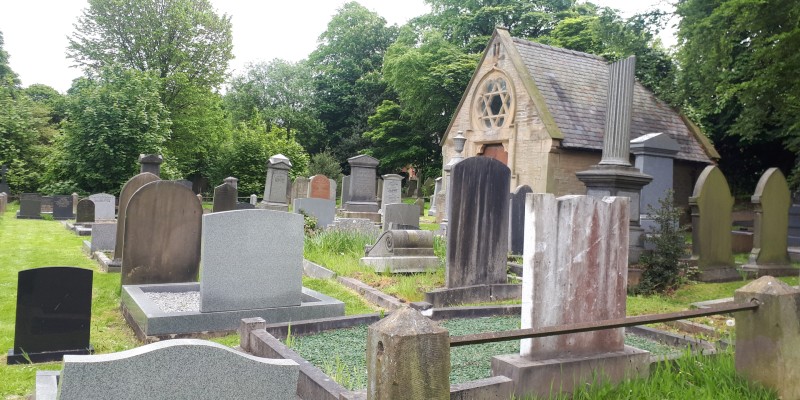
Sophia will share her research on the rise of cremation in the Bradford Reform Jewish community between 1900 and 1935.
Lyman will be presenting on Jewish Women's Embodied Practices in Early Modern Venice.
This event is organised by the Postgraduate Researchers and Early Career Researchers Jewish Studies Network, recently formed under the auspices of the Centre for Jewish Studies at the University of Leeds.
For more information and to join, please email Sophia Lambert at [email protected].
Ashes to Ashes: The Rise of Cremation and its impact on the Topography of Bradford and Berlin’s Weißensee Cemetery 1900-1935
To what extent was cremation practised in the Bradford Reform Jewish community? What was the connection between social class, migrant status and cremation rates among the Bradford Reform Jewry? How did cremation impact the topography of Bradford and Berlin’s Weißensee Cemetery?
Most of those interred in the Bradford Reform Jewish Cemetery from its opening in 1877 until 1914 were German or of German descent. This paper presents a transnational study of cremation, examining how the Enlightenment and the Haskalah (Jewish Enlightenment) influenced German and German Jewish attitudes towards cremation, and subsequently shaped the disposal methods chosen by Bradford’s first-generation German Jewish migrants. Wiesemann and Schumacher-Brunhes’s studies of the rise of cremation among Jewish and non-Jewish Germans have overlooked German Jewish people in the diaspora. Therefore, this paper’s transnational approach is unique and provides new insight into the ongoing dialogue between migrants and their country of origin.
Peter Jupp, among other historians have examined the demographic profiles of the cremated in Britain in the late-nineteenth and early twentieth centuries, overlooking Britain’s Jewish communities. Using information in the Bradford Reform Jewish Cemetery register and the probates of the cremated, this paper develops their work by exploring the connection between social class and cremation rates at a local level in a northern Anglo-Jewish community.
While studies of European Jewish cemeteries have discussed the emergence of new necrographies following the rising number of cremations, the existing literature on Anglo-Jewish cemeteries has only provided a brief overview of this topic. This paper’s discussion of this topic will offer the first detailed study of its kind, expanding the literature by examining the extent to which cremation shaped the topographies of Weißensee and Bradford’s Reform Jewish Cemetery.
About the speaker
Sophia Lambert is a Postgraduate Researcher in the School of History at the University of Leeds. Sophia has worked on several collaborative heritage projects with Leeds Museums and Galleries. She is currently a Project Archivist for the Leeds Jewish Living History Project.
After graduating from Leeds Beckett University with a History BA, Sophia completed a Masters in Social and Cultural History at the University of Leeds. She is now undertaking a PhD in history at the University of Leeds. Her thesis examines Bradford’s Reform Jewish Cemetery and its headstones to explore Jewish people’s attitudes towards integration and assimilation. Her project also investigates how the Bradford Reform Jewry negotiated their identity through their burial ground and mourned and commemorated the deceased.
Shining Heaven, Dark Earth: Jewish Women's Embodied Practices in Early Modern Venice
In this paper, I present my initial findings from the "Sefer Le-Nashim" [The Book for Women], an 18th-century Venetian Jewish manuscript from the Cecil Roth Collection. I begin with a brief overview of Venetian Jewish society in the early modern period and the use of Judeo-Italian as a vernacular dialect, both in general and in relation to Sefer Le-Nashim. I then discuss the book's contents, encompassing household management, medico-religious remedies, and gendered practices of the body, especially regarding pregnancy and childbirth. I close with some reflections on Italian Judaism, women's cultures, and the current boom of interest in folk magic.
About the speaker
Lyman Gamberton received his PhD in Social Anthropology from SOAS in 2022. His area of specialisation is medical humanities, with particular interest in gender, folk culture, and embodied practices. He is currently a 2025-6 Brotherton Fellow at the Leeds Arts and Humanities Research Institute (LAHRI), where he is working with a selection of early modern Italian women's manuscripts from the Cecil Roth Collection of Hebraica and Judaica.
Image
Photo of Bradford Jewish cemetery by Sophia Lambert.